
Introduction
“When there is no enemy within, the enemies outside cannot hurt you.” — African Proverb
The dream of a united, peaceful Africa is as old as the independence movements that birthed modern African states. At the heart of this vision is the African Union (AU)—the continental body charged with promoting peace, integration, and development. With 55 member states under one umbrella, the AU carries immense symbolic and strategic weight. But amid ongoing conflicts, military coups, ethnic divisions, and geopolitical interference, one question looms large: Can Africa’s continental body truly deliver on peace and unity—or is it just a ceremonial force with limited bite?
Discussion
- A Vision Built on Pan-Africanism
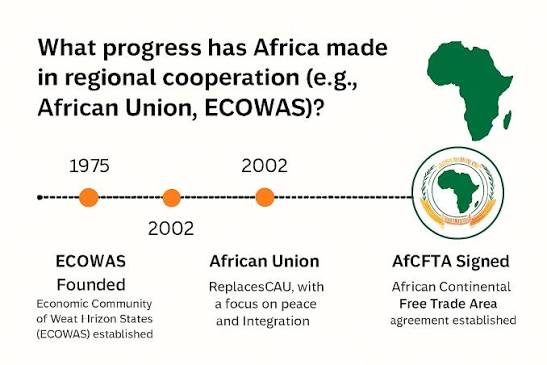
Formed in 2002 as the successor to the Organisation of African Unity (OAU), the AU was envisioned as a more action-oriented body capable of intervening in conflicts, defending human rights, and fostering continental integration. The Constitutive Act of the AU grants it the power to intervene in a member state under grave circumstances—such as war crimes, genocide, and crimes against humanity.
However, while the vision of pan-Africanism has remained strong, translating that vision into practical, sustained unity has proven difficult.
- Persistent Conflict and Instability
From the war in Sudan, the chaos in Libya, insurgency in the Sahel, ethnic clashes in Ethiopia, to military coups in countries like Mali, Burkina Faso, Guinea, and Niger, the continent is riddled with instability. Despite early warnings and policy frameworks, the AU often responds slowly or symbolically, unable to prevent or mediate conflicts decisively.
While it has deployed peacekeeping missions—such as in Somalia under the AU Transition Mission (ATMIS)—such interventions are heavily reliant on external funding, primarily from the EU, China, and the UN. This dependency weakens the AU’s autonomy and effectiveness.
- Institutional Limitations
The AU’s Peace and Security Council (PSC), modeled after the UN Security Council, is supposed to be the nerve center of conflict resolution. Yet, it is often hampered by internal politics, lack of enforcement power, and inconsistent commitment from member states.
The African Standby Force (ASF), intended as a rapid deployment force for peacekeeping and emergency intervention, has remained largely theoretical, with limited real-world operational capacity even after decades of planning.
Moreover, the AU’s budget is modest—less than $800 million as of recent years—with over 60% funded by external partners, undermining its credibility and self-reliance.
- Success Stories and Symbolic Achievements
Despite the challenges, the AU has recorded some notable victories. Its role in mediating the Ethiopian-Tigray peace deal, although largely facilitated by former Nigerian President Olusegun Obasanjo and others, demonstrated that African-led solutions are possible.
Additionally, initiatives like Silencing the Guns by 2030, the African Continental Free Trade Area (AfCFTA), and the Agenda 2063 vision aim to align peace, unity, and development in a common framework.
In West Africa, ECOWAS (a regional bloc) has occasionally stepped in strongly, such as in The Gambia in 2017, forcing Yahya Jammeh to step down after an electoral loss. However, these regional successes often don’t scale to continental consistency.
- The Way Forward: What Must Change?
For the AU to truly deliver on peace and unity, it must:
- Reform its internal mechanismsto ensure independence, faster decision-making, and enforcement capacity.
- Reduce donor dependencyby increasing financial commitments from member states and developing indigenous revenue streams like the AU levy on imports.
- Empower regional blocslike SADC, ECOWAS, IGAD, and ECCAS to work in synergy with the AU rather than in isolation.
- Address root causes of conflict—poverty, bad governance, identity politics, and external manipulation—through policy action, not just declarations.
- Engage more African youth, women, and civil societyin peacebuilding efforts to deepen the culture of unity from the grassroots.
Conclusion
“Wisdom is like fire. People take it from others.” — African Proverb
Africa’s journey to peace and unity is long, winding, and fraught with contradictions. The African Union is not without flaws, but it remains the most viable platform to steer the continent toward collective prosperity. Its effectiveness will not come from speeches or symbolic meetings, but from decisive actions, political will, and genuine commitment to African solutions for African problems.
The continent cannot afford to be divided in a world increasingly defined by blocs, rivalries, and transitions. If Africa must rise, its continental body must rise with it—not just as a dream, but as a decisive force for peace, unity, and sovereignty.
NOAH AJARE ESQ